

Introduction
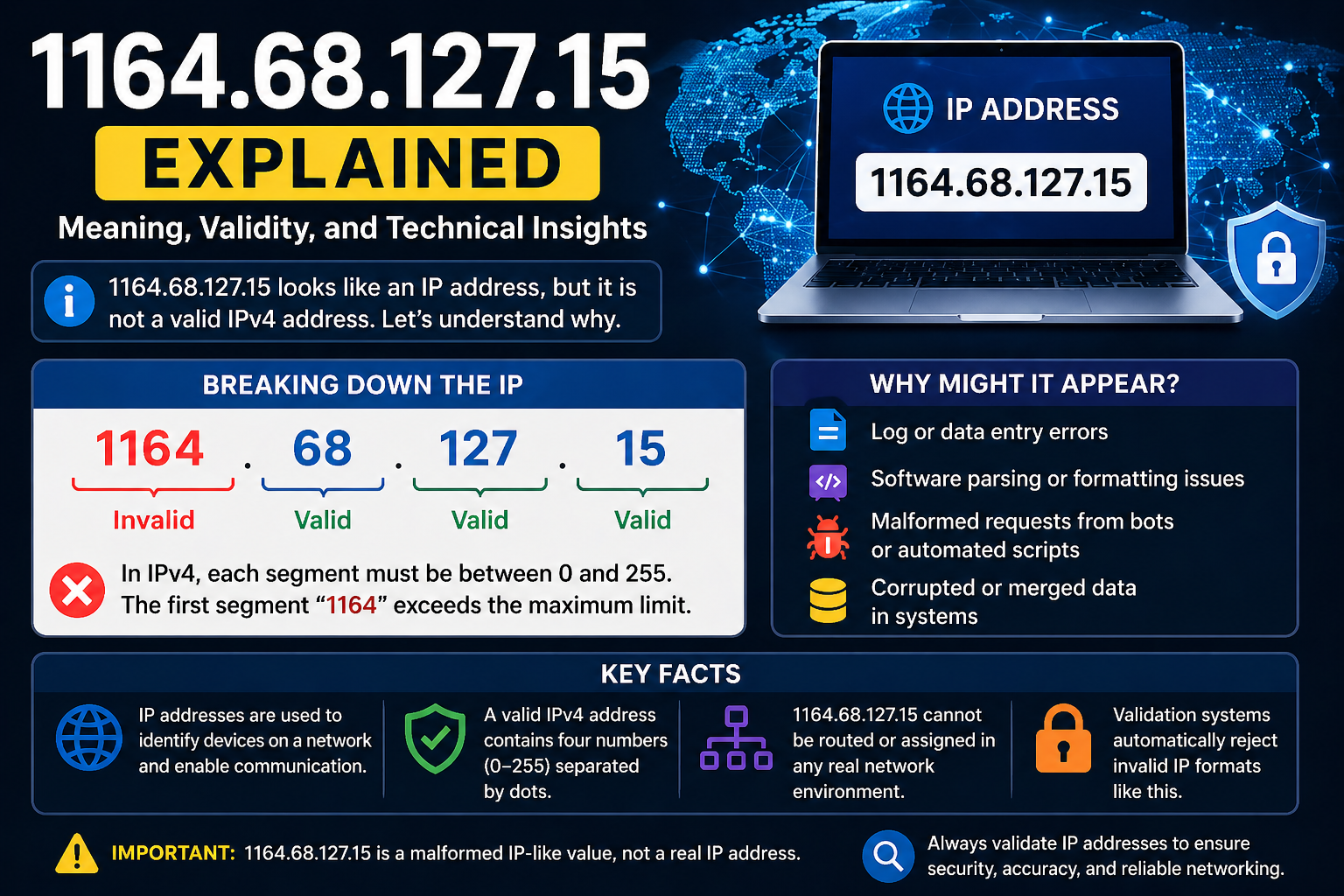
The string 1164.68.127.15 looks like an IP address, but in technical networking terms it is not a valid one. At first glance, it follows the familiar dotted format used in IPv4 addressing, which is why it often creates confusion among beginners and even appears in system logs or online discussions. However, a deeper look into how internet protocols work shows that this value breaks fundamental rules of IP addressing.
To understand it properly,1164.68.127.15 we need to explore what IP addresses are, how they function, and why this specific format is considered invalid in real-world networking systems.
What an IP Address Actually Means
An IP address is a numerical label assigned to devices connected to a network. It allows computers, servers, phones, and routers to communicate with each other over the internet. Without IP addresses, data would not know where to travel or return.
In IPv4 format, which is the most commonly recognized structure, an IP address consists of four numbers separated by dots. Each number represents a segment called an octet. These octets are essential because they define the identity and location of a device within a network.
Every valid IPv4 address follows strict rules to ensure proper communication between systems.
Why 1164.68.127.15 Looks Like an IP Address
The structure of 1164.68.127.15 resembles a standard IPv4 address because it has four numeric parts separated by dots. This visual similarity often leads people to assume it is a real network address.
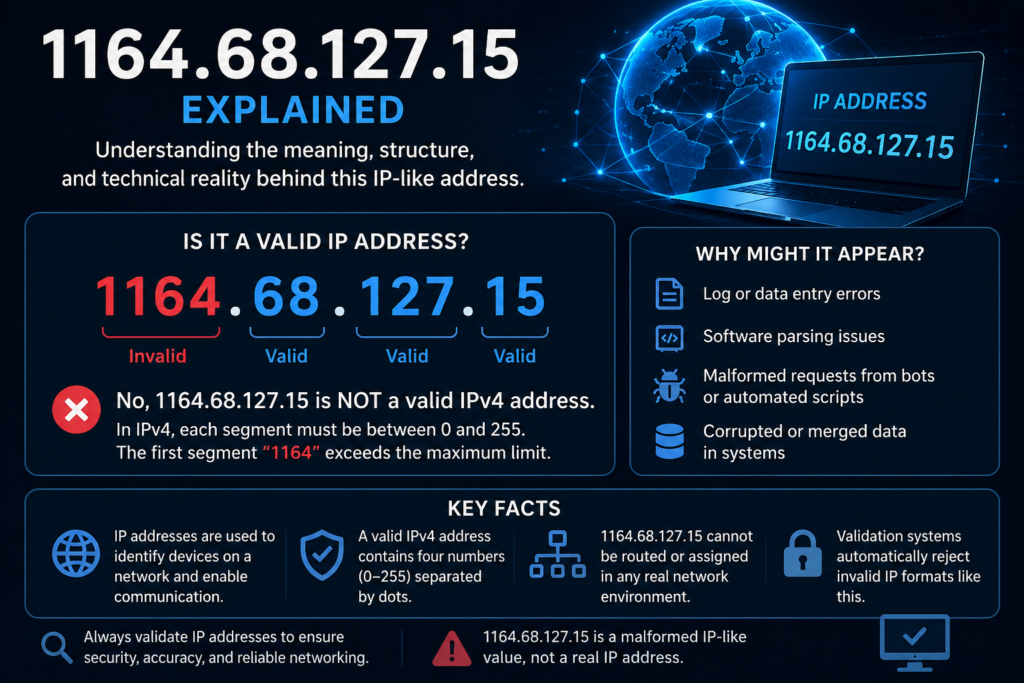
However, the resemblance is only superficial. While most IP addresses fall within a predictable range, this specific value contains an immediate technical violation. The first segment, “1164,” is far outside the allowable limit for IPv4 addressing.
IPv4 addresses are designed to support values between 0 and 255 in each segment, meaning anything beyond this range cannot function as a real network identifier.
Why 1164.68.127.15 Is Not a Valid IP Address
The core reason this value is invalid lies in the structure of IPv4 itself. Each octet is an 8-bit number, and 8 bits can only represent values from 0 to 255. Once a number exceeds 255, it can no longer be represented within the IPv4 system.
Since the first segment of 1164.68.127.15 is 1164, it breaks this rule completely. This makes the entire address unusable in real networking environments. No router, server, or operating system can assign or route this value as a legitimate IP address.
In simple terms, it is not just incorrect—it is mathematically impossible within IPv4 design.
How Such Invalid Formats Appear in Systems
Even though 1164.68.127.15 is not real, it can still show up in logs, databases, or software outputs. This usually happens due to errors rather than intentional usage.
One common reason is data corruption during processing. When systems handle large amounts of network traffic, small parsing mistakes can combine numbers incorrectly, producing invalid outputs that resemble IP addresses.
Another cause is software bugs where data fields are not properly validated. If a system fails to check whether an IP address follows correct rules, it may store or display incorrect values like this.
In some cases, automated scripts or bots generate malformed network requests, which can also result in similar patterns appearing in logs.
The Role of IP Address Rules in Preventing Errors
The internet relies heavily on strict rules to function correctly. IP addressing rules ensure that every device has a unique and valid identifier. Without these rules, network communication would fail completely.
Validation systems in modern software are designed to reject any value that does not fit IPv4 or IPv6 standards. This means an address like 1164.68.127.15 would be immediately blocked or ignored.
These validation systems are essential because they prevent broken data from entering critical infrastructure such as routers, firewalls, and servers.
Security Perspective on 1164.68.127.15
From a cybersecurity point of view, invalid IP-like strings are not dangerous by themselves. However, they can still be useful indicators when analyzing system behavior.
Security tools often scan logs for unusual patterns, including malformed IP addresses. If such entries appear repeatedly, it may suggest issues such as misconfigured systems, bot activity, or software errors.
While 1164.68.127.15 is not a real threat, its presence in logs could still help analysts identify underlying technical problems or unusual network behavior that requires attention.
Why Systems Strictly Reject Invalid IP Addresses
Modern networks are built with strict validation layers to ensure data integrity. When a system receives an input like 1164.68.127.15, it does not attempt to process it further.
Instead, the system checks each segment of the address. If any part violates the allowed range, the input is rejected immediately. This prevents errors from spreading through network infrastructure.
Firewalls, routers, and servers all rely on this validation to maintain stable communication across the internet.
How Developers Prevent Issues Like This
To avoid malformed entries, developers use validation techniques at both application and server levels. Input data is checked before it is stored or processed, ensuring that only valid IP addresses are accepted.
This helps maintain clean logs, accurate analytics, and secure network communication. Without proper validation, systems could easily become filled with incorrect or meaningless data, making troubleshooting extremely difficult.
Strong validation practices are one of the most important parts of modern network programming.
Misinterpretations and Human Errors Behind the Value
In many cases, values like 1164.68.127.15 come from simple mistakes. A user may accidentally enter incorrect numbers, or a system may misread data during processing.
Sometimes, multiple values can merge due to formatting errors, creating a single invalid string that resembles an IP address. These issues are usually harmless but can create confusion during system analysis.
Understanding these errors helps engineers identify whether a problem is technical or simply a data entry mistake.
Conclusion
The value 1164.68.127.15 is not a valid IP address and cannot exist in real networking systems due to strict IPv4 rules. Its structure breaks fundamental numerical limits, making it technically impossible for use in communication or routing.
However, despite being invalid, it still has relevance in technical analysis. It can appear due to system errors, logging issues, or data corruption, and studying such anomalies helps improve network reliability and security monitoring.
Ultimately, understanding why values like this are invalid strengthens our knowledge of how the internet works and why strict protocol rules are essential for global digital communication.
